
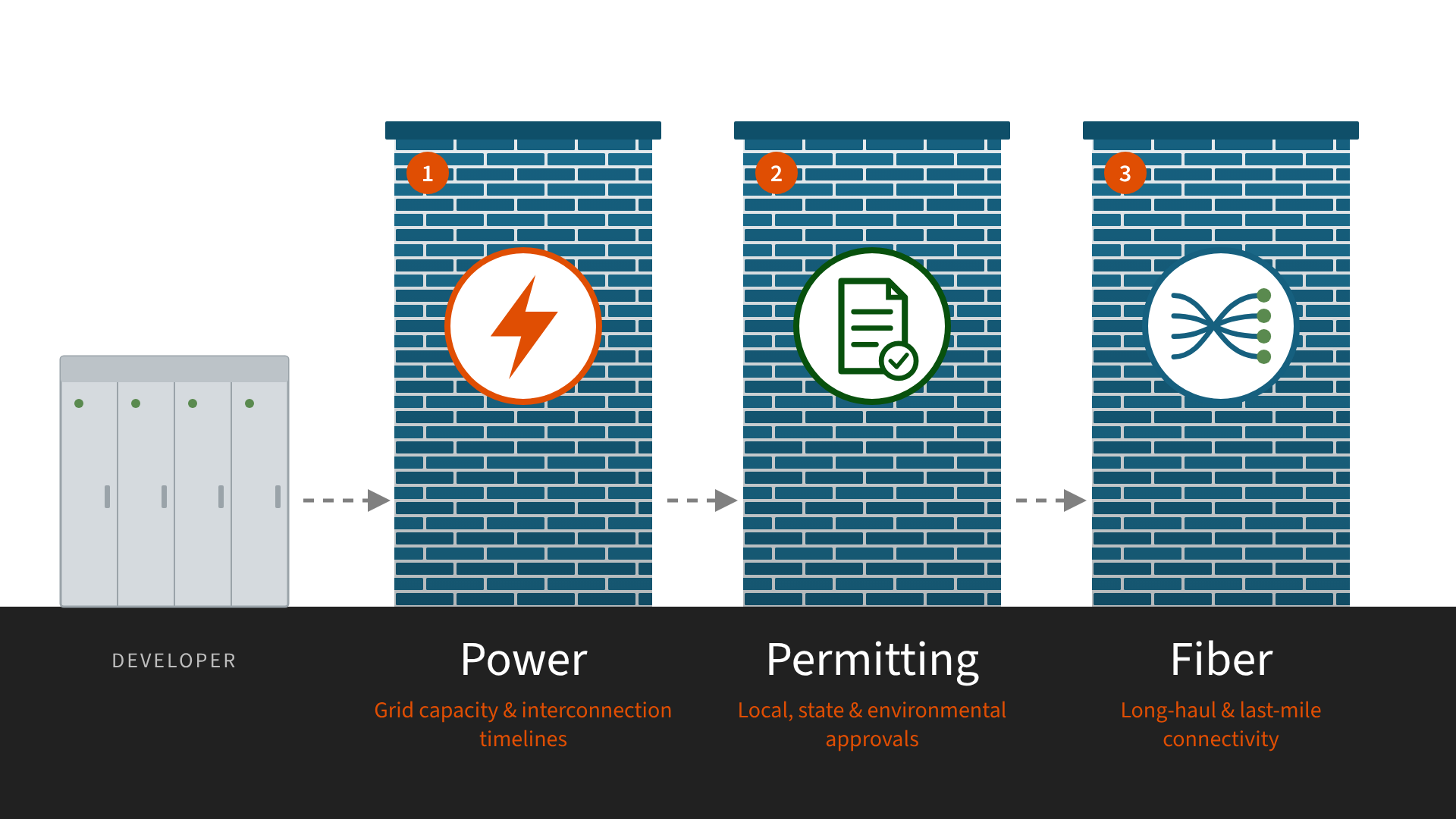
Data center developers are under pressure to bring compute power online as fast as possible, and in Texas, they keep running into the same three walls: power, permitting and fiber. This is likely the case in other states too. Each one can add months or years to a project before a single rack goes in. B2U Storage Solutions has some options to accelerate time-to-power. Let's dive in.
Why this matters in Texas right now
With the recent mid-term elections, data center development in Texas is less predictable. The governor-elect, Gina Hinojosa has pledged to pause data center approvals at the beginning of her term and will encourage the Democratic-led legislature to pass laws giving residence more say in these projects. ERCOT and the state's Public Utilities Commission began to audit the grid connection process, including data centers in the queue. The TCEQ has paused data center permits, including air and water permits until the audit is completed in December 2026. San Antonio now requires council approval for each project.
How can you keep your project moving in Texas? Evaluate existing energized interconnections and consider designing loads well below most large-load review thresholds.
B2U has a portfolio of grid-connected sites in Texas where all three have already been worked through:
10+ sites across San Antonio, Houston, Dallas and South Texas, each with a ~10 MW grid interconnection with additional sites in California
60+ MWs of interconnection capacity across the portfolio
240+ MWhs of storage capacity available
Battery storage operating or ready to build at every site
Here's how each barrier has been de-risked.
#1. Power: an energized interconnection, not a queue position.
The interconnections are already studied and in place. Using them for data center load is a utility approval, not a new trip through the interconnection queue.
Studied and energized. Every site has a utility-studied ~10 MW interconnection. Utilities studied these sites assuming full battery charging at the worst possible time, so the grid impact of an equivalent load is already understood.
Months, not years. Converting an existing interconnection takes targeted updates to protection, metering, and telemetry. It doesn't take a new impact study and years of grid upgrades. That means months, compared with the 4–7 years typical for new large-load service. Utilities generally prefer serving a retail customer to a wholesale market participant, and CPS Energy has already shown interest at our San Antonio sites. B2U leads the process and files the updates once a buyer commits.
Reliable by design. These are non-load-shed interconnections, not interruptible or curtailable service. Battery storage onsite adds emergency ride-through. Both are valuable power requirements for data centers.
#2. Permitting: screened for low risk, accelerated by phased backup power
We've run site-level screens for land, zoning, flood, wetlands and water. Permitting isn't expected to hold up most sites. Here’s what B2U has done to de-risk permitting:
Land: Buildable acres mapped at every site, outside the floodplain and net of the battery. We estimate 0.3-0.5 acres per MW of data center capacity and lay out specific modular products on each site.
Zoning: Most sites are unincorporated with no zoning, eliminating zoning concerns. City zoned sites are flagged.
Air: Onsite storage carries the site through grid disruptions for hours, beyond UPS and short of multi-day events, so backup generators run less.
Water: B2U battery energy storage systems use closed loop radiator and air cooling with no process water. Paired with closed loop modular cooling, site water use stays minimal.
Stormwater: Covered under TCEQ's construction general permits are scaled to the ground actually disturbed. Modular data centers are built on prepared pads keeps it small.
Managing the air permitting process matters most to stay on schedule. Compute can come online sooner on grid power plus battery ride-through, while generator permits proceed in parallel.
#3. Fiber: available at or near every site, with multiple routes
Every site has been screened for fiber, and carriers are confirming service and pricing.
Multiple providers can serve most sites, with diverse routes and dark fiber offered at many.
Redundancy sized to your SLA. GPU workloads can often start on one feed and add a diverse route later if needed.
A known line item. Fiber is a cost and schedule line we can quote, not an open question.
The bottom line
Most data center timelines are set by what takes the longest; power, permitting or fiber. Across this portfolio, all three have been de-risked ahead of time: an energized ~10 MW interconnection, a low-risk permitting path with phased backup power, and fiber that can be quoted today.
If you're looking for powered land in Texas that can host compute in months rather than years, get in touch with the B2U team to talk through specific sites. And if you already have an approved site, B2U can add energy storage that can be deployed in months. Learn more about how B2U helps data centers with energy storage solutions.